
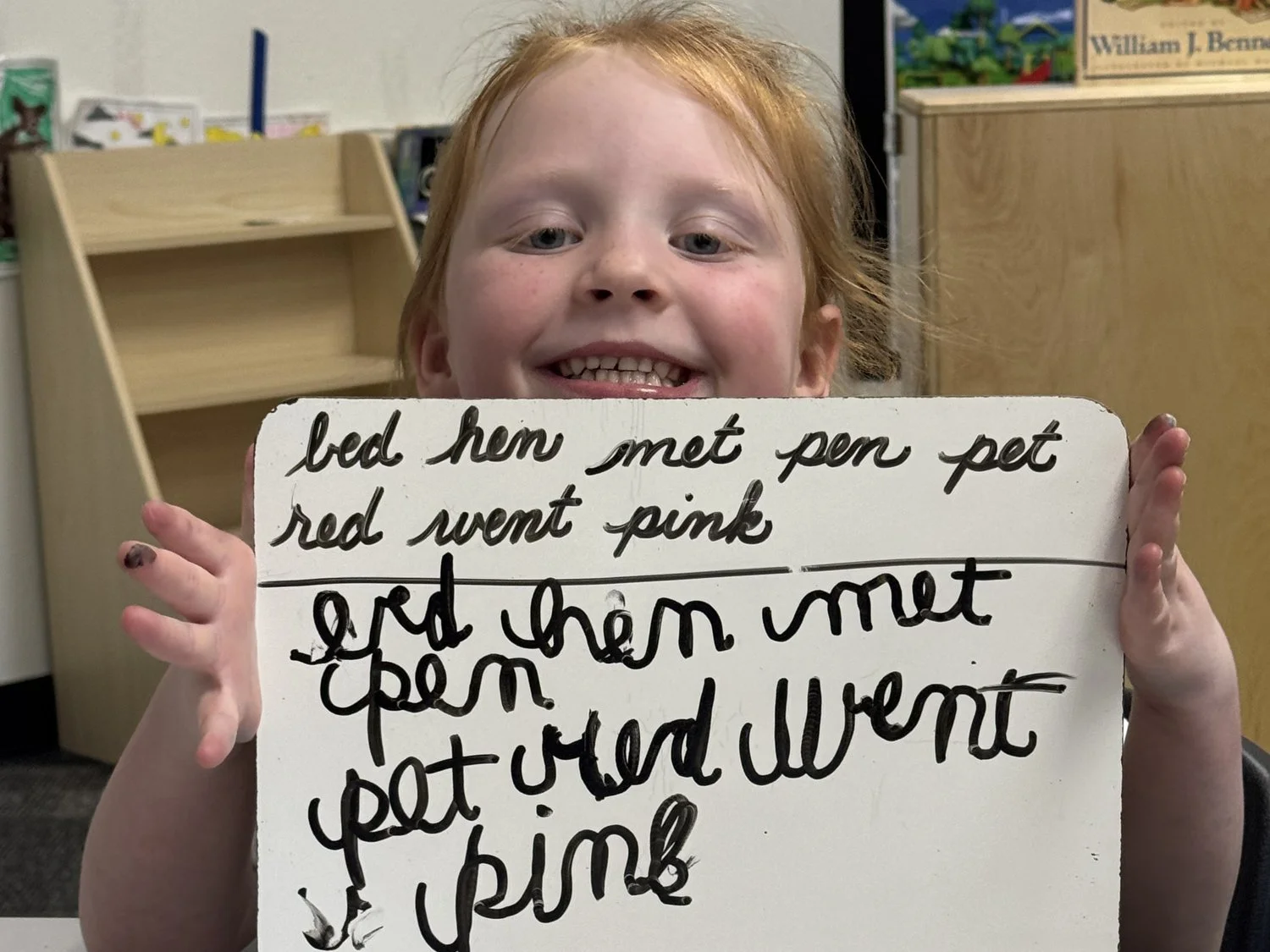
Parents who visit our Kindergarten often notice something right away: the children are writing in cursive. Most are glad to see it. Cursive builds fine motor skills and grip strength, and it gives a young child a strong foundation for writing.
At Calvary Christian Academy, children learn to write in cursive from the very beginning, and it is not only a Kindergarten thing. Cursive is how our students write across the whole school, Kindergarten through 6th grade. Here is why we do it.
What We Actually Do
Handwriting at CCA starts in cursive with a program called Cursive First, which our teachers use for formal handwriting instruction from Kindergarten through 3rd grade. After that, cursive simply stays the way our students write, all the way through 6th grade. It works hand in hand with Spell to Write and Read, a phonics program that teaches spelling and writing together, so a child learning the sounds of a letter is also learning to form it.
We do not formally teach printing at all. Children still read printed books from the start, since their phonics readers are printed and so is nearly everything else they read, and they pick up print naturally through all that reading. What changes is what their hands learn first.
Easier for Young Hands
Printing asks a five year old to lift the pencil, find a new starting point, and stop again, often several times inside one letter. In Cursive First every lowercase letter begins from the same place, the baseline, so a child is never guessing where to put the pencil down. From there each letter is one flowing movement, and the pencil stays on the paper as the letters join into a word.
That flow suits English itself. Print is static and choppy, a row of separate marks. Cursive moves the way a word sounds, from one letter into the next.
It also helps children who learn by doing. Forming a letter in one continuous motion gives a child's hand and arm something to remember, which is a real help to kinesthetic learners.
Fewer Mixups, More Time to Think
Because b and d, or p and q, are formed so differently in cursive, children mix them up less often. Our teachers find this especially helpful for children who struggle with reversals.
Cursive also slows a child down at exactly the right moment. In Kindergarten a single phonogram can make up to three sounds, and the time it takes to form a letter carefully is time to sound it out. The hand and the ear learn the letter together.
Faster, Which Matters Later
A child who writes comfortably and quickly can keep their attention on what they are saying rather than on how each letter is shaped. That matters more every year, and by 4th grade, when our students begin the Institute for Excellence in Writing and start composing paragraphs and essays, a fluent hand is a real advantage.
A Habit of Care
Cursive asks a child to slow down and do something carefully, every day, until it is done well. That is not a small thing. Diligence is one of the four virtues in our CORD Honor Code, and the Scripture behind it is Colossians 3:23: whatever you do, do it heartily, as to the Lord.
A page of careful letters is one of the first places a young child gets to practice that. It is also one of the first pieces of work they are truly proud of.
Come and See It
The easiest way to understand this is to see it. On a visit, ask to look at a Kindergarten or 1st grade notebook, and you will see what a few months of patient practice can do.
Financial Aid Available As God Provides.
Laura Castillo
Application and Enrollment Coordinator
775-333-6271
info@ccareno.org